DNA, dominant and recessive alleles, Punnett squares, inherited traits… there’s a LOT for middle schoolers to wrap their heads around in a Genetics and Heredity unit!
And while genetics is one of those science topics that naturally sparks students’ curiosity (Who doesn’t want to know why they have their mom’s eyes or their dad’s curly hair?!), it can also get pretty confusing once all those letters and vocabulary words start flying around.
I love teaching genetics because there are so many opportunities to get students thinking, problem-solving, and modeling concepts that they can’t actually see. I like to have them think about looking at everyone’s different noses while they are at church or shopping in the grocery store — everyone has a unique nose! Why?! And there are some REALLY fun ways to help them understand how genetic information gets passed from one generation to the next!
I’ve rounded up some of my favorite middle school genetics and heredity activities and organized them into a sequence that builds from the structure of DNA all the way to predicting inherited traits. Whether you’re planning an entire unit or just looking for a fresh activity to add to your lessons, I hope you’ll find something here that your students will love!
1. Hook Your Students with a Crime Scene!
What better way to kick off a DNA unit than with a little mystery?!
Instead of starting with a bunch of vocabulary words, introduce your students to a simulated crime scene and challenge them to figure out who committed the crime using DNA evidence.
Here’s how I would use this activity: Introduce the crime scene at the beginning of your DNA lessons, but don’t let students solve the mystery just yet.
Set up a faux “crime scene” in the classroom. Use Crime Scene tape and trace a body with chalk on a piece of large black roll paper. Have this set up on a Monday morning so students are excited and wondering what is going on as soon as they enter your classroom.
Tell a dramatized story that there was a murder in your classroom over the weekend of a man named _____ (I just call him “Mr. Body” and talk about how he was a “bad guy” involved in a lot of risky, illegal business). Explain that you were originally a suspect, but that you had an alibi and they deemed you innocent. The FBI was called in and they have narrowed the suspects down to five.
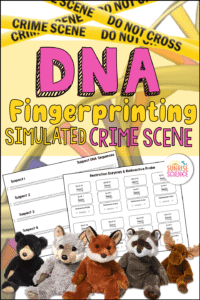
Use stuffed animals as the suspects. Depending on the types of stuffed animals you have on hand, give each suspect a name and a story about their involvement with Mr. Body. In the teacher notes of this resource I give ideas for why each stuffie is a suspect!
Leave them wondering about the evidence as they learn about the structure and function of DNA over the next few class periods. Then, once they’ve developed some background knowledge, bring them back to the crime scene to analyze the DNA fingerprinting evidence and identify the suspect. It’s so motivating having a mystery hanging over the classroom while students are learning. It gives them something to look forward to and a reason to care about what they’re studying.
Explore the DNA Fingerprinting Crime Scene Activity
2. Let Students Discover the Structure of DNA
DNA is such an amazing molecule, but it’s also pretty abstract for middle schoolers. Before asking students to memorize the parts of a nucleotide or the rules of base pairing, why not let them do a little scientific detective work?
My DNA Structure and Replication 5E Lesson gives students the opportunity to explore how scientists pieced together the structure of DNA over many decades.
Students begin by deciphering a secret message and then work through The Puzzle of DNA, examining evidence from scientific discoveries between 1869 and 1953.
As they analyze data, diagrams, and discoveries, they gradually figure out the structure of the DNA molecule. Then they use manipulatives to construct their own model.
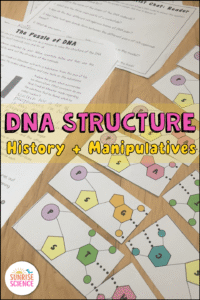
One of my favorite parts of this lesson is the Scientist Chat, where students take on different roles and discuss what they’ve learned from their models.
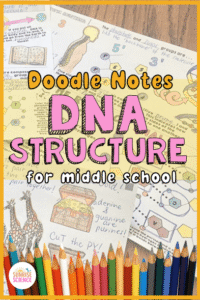
After the inquiry activities, students complete DNA Structure Cornell Doodle Notes to organize and reinforce their understanding of nucleotides, the double helix, the sugar-phosphate backbone, and nitrogenous base pairing.
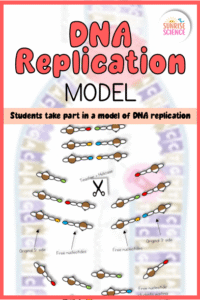
The lesson also introduces DNA replication, including a human modeling activity to help students visualize how DNA makes copies of itself. You’ll need some red, green, blue, and orange socks for students to put on their hands as the nucleotides. Detailed directions are included in this 5E Lesson on how to facilitate the activity as the “Teacher Helicase”.
This is the kind of lesson sequence I love because students get to DO something with the science before they’re expected to remember all of the terminology.
3. Introduce Heredity and Punnett Squares with Cornell Doodle Notes
Once students understand what DNA is and how genetic information is stored, it’s time to tackle the big question: How do traits get passed from parents to offspring?
This is where Gregor Mendel, genes, alleles, genotypes, and phenotypes enter the picture!
My Heredity Cornell Doodle Notes introduce students to Mendel’s pea plant experiments and the basics of dominant and recessive inheritance.
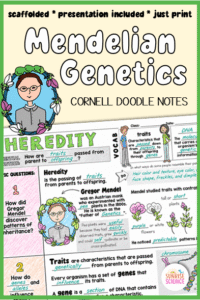
Students learn the difference between homozygous and heterozygous genotypes, identify genotypes and phenotypes, and practice using Punnett squares to predict possible allele combinations in offspring.
I especially like using visual notes for this part of the unit because students have SO many new vocabulary words to keep straight.
The notes combine diagrams, examples, coloring, and practice questions to help students organize the information without feeling like they’re just copying definitions for an entire class period.
And when you get to Punnett squares, be sure to emphasize that they show probability, not certainty!
A Punnett square might predict that 25% of offspring will inherit a particular genotype, but that doesn’t mean exactly one out of every four offspring will have it.
That’s an important distinction that will come up again in the next activity!
4. Go Beyond Dominant and Recessive Traits
Just when students think they’ve got genetics all figured out… it’s time to throw a little curveball their way!
Not every trait follows a simple dominant-recessive pattern.
My Patterns of Inheritance Cornell Doodle Notes introduce students to several other ways traits can be inherited, including:
- Incomplete dominance: When the heterozygous phenotype is intermediate between the two homozygous phenotypes, like red and white flowers producing pink flowers.
- Codominance: When both alleles are fully expressed, like the red and white hairs of a roan cow.
- Multiple alleles: When a gene has more than two possible alleles in a population, as with the ABO blood type system.
- Polygenic traits: When multiple genes influence a single trait, such as human height or eye color.
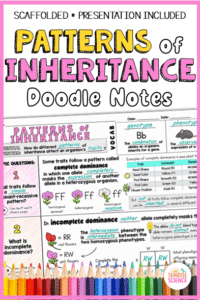
The notes include visual examples, comparisons, and Punnett square practice to help students recognize the differences between these patterns.
I think it’s especially important for students to understand that inheritance isn’t always as simple as a capital letter winning over a lowercase letter!
And once they’ve learned about these different patterns, they’re ready for one of the most entertaining activities in the unit…
5. Make a Baby! The Baby Face Genetics Activity 👶
Okay, this one is FUN.
For my Baby Face Genetics Coin Toss Activity, students work with a partner to simulate the inheritance of traits in an imaginary baby.
All you need are some coins! Each student represents a parent, and the partners flip coins to determine which alleles are passed along to their offspring.
They work through 27 different traits, including hair characteristics, eye characteristics, facial features, and more. The activity also introduces simplified models of polygenic and other inheritance patterns.
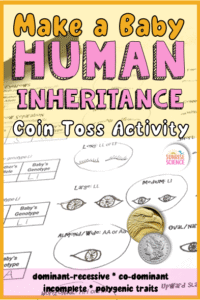
Once they’ve determined their baby’s inherited traits, students work together to draw their baby and create a baby announcement!
And the best part?
Even though the simulated parents begin with the same genotypes, the offspring can end up looking VERY different!
It’s such a fun way to illustrate genetic variation and reinforce the idea that offspring inherit a combination of alleles from their parents.
A quick teaching note: The human traits in this activity are simplified for modeling purposes. Many real human characteristics are influenced by multiple genes and environmental factors. I would make that distinction clear to students so they understand that the coin tosses are modeling inheritance, not predicting exactly what a real baby would look like!
Explore the Baby Face Genetics Activity
6. Review Genetics with Task Cards… with a Twist!
By the end of a genetics unit, students have learned a LOT of vocabulary and concepts. And let’s face it, another review worksheet isn’t always the most exciting way to wrap things up.
That’s why I love using Task Cards with a Twist! My Genetics and Heredity version includes 28 multiple-choice questions covering concepts like Mendel’s experiments, genotypes and phenotypes, Punnett squares, patterns of inheritance, meiosis, and genetic variation.
But here’s the twist! Each answer choice has a word associated with it. As students answer the questions, they collect words that they’ll use to complete a mystery Mad Lib-style song. They don’t get the song until AFTER they’ve answered the questions, so there’s an extra incentive to work through the review carefully.
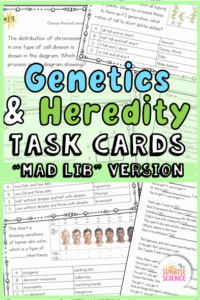
You can tape the task cards around the classroom and have students move from question to question, or use the digital version.
I love activities like this because students are still doing meaningful review, but it feels a little less like test preparation and a little more like a challenge.
Explore the Genetics and Heredity Mad Lib Task Cards
Bringing It All Together
Genetics and heredity can be a challenging unit for middle schoolers, but it can also be one of the most interesting!
Students are naturally curious about why living things look the way they do, why siblings can look so different, and how something as tiny as a DNA molecule can carry so much information.
By combining inquiry activities, models, visual notes, and a few creative projects, we can help students move beyond memorizing genetics vocabulary and actually start making sense of inheritance.
I hope these activities give you some fresh ideas for your next DNA, Genetics, and Heredity unit!
Check out my Genetics and Heredity Activities bundle with the resources from this blog post:
Happy teaching!
Karla


