This sounds really nerdy but I absolutely love the Periodic Table. I think it’s one of the most fascinating tools in science and I love bringing it to life for my students. I have created a lot of resources around the Periodic Table because as a young student I never really appreciated its usefulness. Through college and grad school, I really did.
This ‘Periodic People’ activity has become a favorite lesson and definitely my favorite way to introduce the concept of the Periodic Table as a table of patterns! This activity was adapted from the Oakland Schools Chemistry Resource Unit. The original activity includes a perfectly useful but more simplistic version of the ‘Periodic People’ cards. Somewhere along the way, I found the cutest set of these that had been re-drawn by an artist named Renee Kimpel. She had them on her blog for free download. Unfortunately, I have not been able to find Renee and her blog again to give her proper credit (if you do know about this blog or where the re-drawn Periodic People can be found, please leave this in the comment section below!).
I am providing a FREE DOWNLOAD of this resource, so be sure to scroll to the bottom to grab the freebie!

This is a hands-on inquiry-based activity for which students are introduced by an engaging prompt:
You have been chosen for this top secret mission. Your mission, should you choose to accept it, is to work with the “sketches” of the suspicious characters on the secret agent list. They are part of a family of secret agents, but the most deadly of all has never been sketched. Your job is to arrange the sketches in a pattern so that you can draw the missing secret agent.
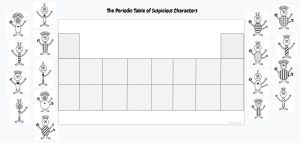
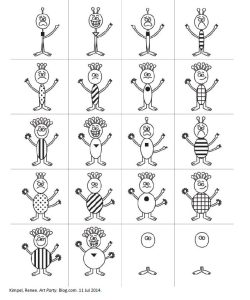
In groups of two or three, students will figure out a way to arrange 17 drawings of ‘Periodic People’ into a table that considers patterns. There are patterns going up and down and across from left to right! These patterns include the body size (skinny to fat), the number of antennae (1 to 8), the number of fingers (1 to 18), the number of arms (1 to 3), the facial expression (really sad to super happy), and the body design pattern (9 different ones). These patterns are synonymous with the major patterns on the Periodic Table itself– the number of electron shells increases moving down a column, the number of valence electrons increases moving from left to right across a row, the electronegativity increases moving from left to right across the main group elements, etc.
If you’ve already taught atomic structure, then your students may recognize these ‘personified’ patterns themselves! The number of arms represents the number of electron shells, the number of antennae represents the number of valence electrons, the number of fingers represents the atomic number. This year, one of my students even noticed something I hadn’t before– the number of fingers on each specific hand represents the number of electrons in each specific electron shell (K, L, and M). I gave myself a secret HIGH-FIVE when he pointed this out to me!
But, don’t worry, you can use this awesome activity even if you haven’t taught these patterns yet! Either way, I have a great activity in my TPT store that works perfectly before (while teaching atomic structure) or after this one! (Check out my Bohr Atoms Diagrams Manipulatives Activity.)
You can grab this PERIODIC PEOPLE ACTIVITY, including the people cards, teacher notes and table answer key! And I have added a digital Google Slides version of the activity, too! Click the link above to download the resource and get the Make a Copy link!