When I was in elementary school I was obsessed with the idea of space and astronauts. I remember consistently requesting permission from my 4th grade teacher for my best friend and me to be allowed to go to the library for recess instead of out to the playground. We would beeline straight to the non-fiction space section and sit together on a beanbag chair, filling our minds with all the possibilities of space! It went a bit too far when we ventured into the realm of UFO’s and aliens– I also remember asking my dad to sleep on the floor in my room because I had become so terrified of the threat of an alien invasion! Yikes!
But I say all of that because I think kids have an innate interest in the idea of space, and the amazing thing is that as the decades pass and science advances, we know so much more and so much less about the universe all at the same time! I mean, what kid’s eyes don’t alight with curiosity when considering the idea of performing a tether-free space walk or of a man-made vehicle entering interstellar space!? I taught an Astronomy enrichment course for three years and absolutely loved the discussions that arose in that class of 8th graders. I myself would get caught up in the mysteries and excitement of space exploration. Together my students and I would be overtaken by that cognitive conflict and humbling whiplash that hits you when you start envisioning zooming out from Earth into the great universe.
The history of space exploration of course truly began centuries ago when Greek philosophers pondered the night skies and argued over whether Earth was truly the center of the universe. But, fast forward to 1957 when the Soviets launched Sputnik and the Space Age was born, compared to centuries of snail’s pace paradigm shifts, progress and knowledge about space suddenly became relatively exponential!
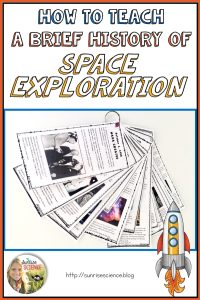
So you’re teaching a space unit and you’d love to give your students a history lesson about space exploration? I had the same objective and was overcome with sheer overwhelm with the number of events sprinkled throughout the past 60 years! I created this History of Space Exploration Timeline Activity to distill those 60 years to the most significant events. This activity provides students the opportunity to practice ordering events chronologically, to pull requested facts from informational text, to consider the types of events that are most intriguing to them, and to research recent exciting events in space exploration.

The 29 event cards each provide an event title, the date, a description, and a photo/caption from the NASA galleries. There is a 4-page student timeline worksheet, which has a box for each of the 29 events. On their timelines, students fill in the event title or date for each event and answer some comprehension questions about the event.
These are the exciting events! The first animal and humans in space, the Apollo missions, the moon landing, the Challenger and Columbia explosions, the launch of the Voyagers, the Hubble and Kepler Space Telescopes, landing rovers on Mars, creating the International Space Station, the first space walk and untethered space walk, and more!
The event cards are included in two sizes, which will allow for different uses, as described below:
- Print sets of the larger version of the cards and timeline date markers. Cut them out and give them to student groups out of order. Students will first put the events in chronological order and mark the decades with the date cards. Then, they will complete their timeline worksheets.
- Print the smaller version of the cards and timeline date markers. Give students the sheets out of order. The students will have to cut out the cards and follow the procedure above, but could glue their cards onto a poster that they can decorate and use to complete their timeline worksheets.
- Print the larger version of the cards and hang them around your classroom in chronological order. Students will travel around on a ‘gallery walk’ to complete their timeline worksheets.
- Print either version of the cards, make sure they are in chronological order, punch a hole in the top corner, and bind them into a ‘booklet’ with a metal ring. Hand out the booklets to student groups to use to complete their timeline worksheets.


There are also blank timeline cards included, which you could use to add other events, or have students research and add other events. The 5th student page offers students a chance to research at least 3 recent events (since 2015) in space exploration. Web links are provided to help direct students in their research. This assignment will allow the students to follow their curiosities about recent space endeavors!
If you are interested in checking out this resource, click HERE!